
The Real Cost of a Ransomware Attack for UK SMEs in 2026
- April 7, 2026
- Posted by: Gradeon
- Categories: Compliance, Cyber Security
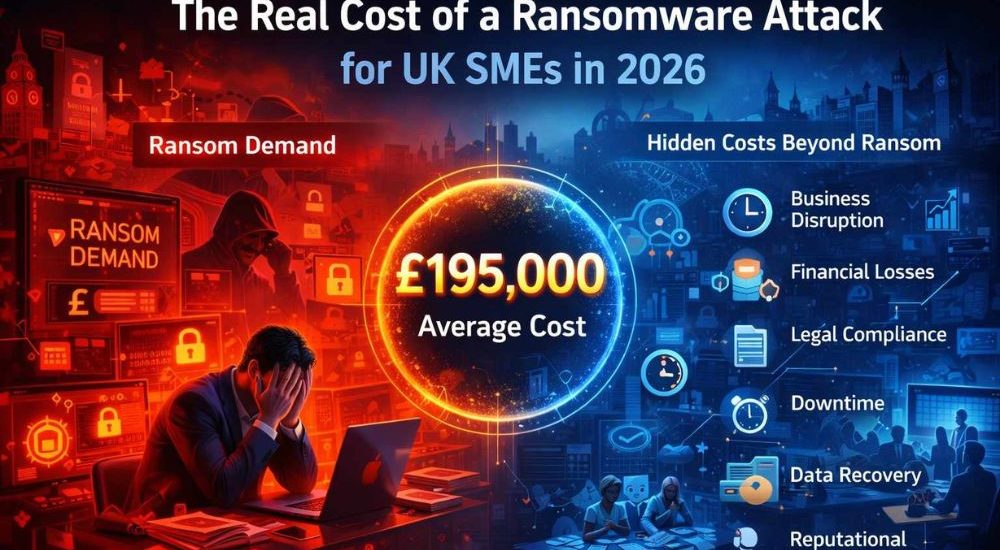
The ransom demand is rarely the most expensive part of a ransomware attack. For most UK SMEs, it is the smallest line on the final invoice.
According to independent research commissioned by the Department for Science, Innovation and Technology in 2025, the average cost of a significant cyber attack on a UK business is almost £195,000. That figure spans all business sizes and sectors. For SMEs without tested backups, a response plan, or cyber insurance, the real cost can be substantially higher, and in some cases, fatal to the business.
This guide breaks down exactly where that cost comes from, what the data tells us about UK SME exposure, and what separates businesses that survive a ransomware attack from those that do not.
Where the Cost Actually Comes From
Most businesses focus on the ransom demand when thinking about ransomware risk. In practice, the ransom is often the smallest cost component, and paying it does not reduce the others.
Operational downtime is consistently the largest single cost category. When systems are encrypted and inaccessible, every hour of lost productivity, lost revenue, and delayed customer delivery accumulates. For a business generating £500,000 per year in revenue, a five-day outage represents roughly £10,000 in direct revenue impact, before factoring in any recovery work.
IT recovery and remediation covers the cost of rebuilding compromised systems from scratch, restoring data from backups (where they exist), patching the vulnerability used as the entry point, and reconfiguring the environment to prevent recurrence. For a business without a specialist IT partner or retained incident response capability, this work is typically outsourced at emergency rates. A CREST-certified incident response firm charges £1,000 to £2,000 per day for this work.
Legal and regulatory costs arise where personal data has been compromised. Under UK GDPR, a reportable breach requires ICO notification within 72 hours, potential investigation, and in serious cases, regulatory fines. For businesses operating under PCI DSS, a confirmed cardholder data breach triggers a mandatory forensic investigation costing £20,000 to £80,000 before any fines or penalties are applied.
Reputational damage and lost contracts are the costs that do not appear on any invoice but can define the long-term impact on the business. Enterprise clients with supply chain security requirements frequently review their supplier relationships following a ransomware disclosure. For businesses in regulated sectors or public sector supply chains, a confirmed breach can result in contract suspension or loss.
Cyber insurance excess and increased premiums apply where insurance exists. Most UK cyber insurance policies carry an excess of £1,000 to £10,000 and virtually all insurers increase renewal premiums significantly, often 20 to 50 percent, following a claim.
UK Ransomware Cost Data, What the Evidence Shows
The UK Government Cyber Security Breaches Survey 2025 and independent research commissioned by DSIT in 2025 provide the most reliable publicly available data on ransomware costs for UK businesses.
| Metric | Figure | Source |
| Average cost of a significant cyber attack, all UK businesses | £195,000 | KPMG/DSIT, 2025 |
| Total annual cost of cyber attacks to UK economy | £14.7 billion | KPMG/DSIT, 2025 |
| Average cost of most disruptive breach, all businesses | £1,600 | Cyber Security Breaches Survey 2025 |
| Average cost where breach had a material outcome | £8,260 | Cyber Security Breaches Survey 2025 |
| Average cost, medium and large businesses with material outcome | £12,560 | Cyber Security Breaches Survey 2025 |
| Estimated UK businesses experiencing ransomware crime per year | 19,000 | Cyber Security Breaches Survey 2025 |
The Cost Breakdown by Category Realistic UK SME Scenario
The table below illustrates a realistic cost scenario for a UK SME with 30 staff, no cyber insurance, limited backups, and no incident response plan.
| Cost Category | Realistic Range |
| Ransom demand (if paid) | £5,000 – £50,000 |
| IT recovery and rebuild | £10,000 – £40,000 |
| Lost revenue during downtime (5–10 days) | £5,000 – £30,000 |
| External incident response consultancy | £8,000 – £25,000 |
| Legal advice and ICO notification support | £3,000 – £10,000 |
| Staff overtime and diverted resource | £2,000 – £8,000 |
| Customer notification and PR | £1,000 – £5,000 |
| Increased insurance premiums (Year 1 renewal) | £1,000 – £5,000 |
| Total realistic cost | £35,000 – £173,000 |
This scenario does not include regulatory fines, PCI forensic investigation costs, or long-term contract losses, all of which can add significantly to the total.
Why UK SMEs Are Disproportionately Exposed
UK SMEs are more exposed to cyber threats because they typically lack dedicated security teams, incident response plans, and robust protections compared to larger organisations. Government research shows 43% of UK businesses faced a cyber attack in the past year, with ransomware incidents doubling recently. Attackers specifically target SMEs due to weaker defenses and limited recovery options, making them more likely to pay ransoms.
This makes one point clear: investing in preventative security measures such as backups, MFA, and monitoring is far more cost-effective than dealing with the financial and operational impact of a ransomware attack.
What Reduces the Cost of a Ransomware Attack
Three factors consistently separate low-cost recoveries from high-cost ones.
Tested, offline backups. Businesses that maintain clean, recent backups stored in a location the ransomware cannot reach, offline or in a separate, isolated cloud environment, avoid the ransom decision entirely. They lose time, not data. Recovery takes days, not weeks.
Cyber insurance with an incident response provision. Businesses with cyber insurance that includes pre-approved incident response firms can activate specialist support immediately, at insurer rates rather than emergency-market rates. Knowing the immediate steps to take when ransomware hits your business, and having a provider ready to execute them, dramatically reduces both technical recovery time and total cost.
A tested incident response plan. Organisations that had documented and rehearsed their response before an attack consistently reported lower costs, faster recovery, and cleaner ICO notifications than those making decisions under pressure with no plan. Choosing the right cyber insurance for your UK business before an attack occurs, rather than after, is one of the clearest financial decisions an SME can make.
Frequently Asked Questions
What is the average cost of a ransomware attack on a UK SME?
Independent research commissioned by DSIT in 2025 found the average cost of a significant cyber attack across all UK businesses is £195,000. For SMEs without backups or cyber insurance, costs commonly fall in the £35,000 to £100,000 range.
Is the ransom demand the biggest cost in a ransomware attack?
No. Operational downtime, IT recovery, legal costs, and reputational damage typically exceed the ransom demand. Many businesses that pay the ransom still face six-figure total costs.
Do most UK SMEs have cyber insurance that covers ransomware?
The Cyber Security Breaches Survey 2025 found that 62% of UK small businesses have some form of cyber insurance, up from 49% in 2024. However, coverage varies significantly, many policies have exclusions or excess levels that reduce their practical value in a ransomware scenario.
How long does a UK SME typically take to recover from ransomware?
Recovery time depends almost entirely on backup availability. With clean, tested offline backups, recovery commonly takes 2 to 5 days. Without usable backups, full recovery can take 3 to 8 weeks, with some systems never fully restored.
Does paying the ransom reduce the total cost of an attack?
Rarely. The NCSC advises against payment and notes that decryption tools provided by attackers are frequently unreliable. Paying the ransom does not prevent legal costs, regulatory obligations, or reputational damage, and marks the business as a willing payer for future targeting.
How can a UK SME reduce ransomware risk cost-effectively?
The most effective security measures are offline tested backups, multi-factor authentication across all accounts, annual penetration testing to identify vulnerabilities before attackers do, and a documented incident response plan. These typically cost under £10,000 per year for a small business, which is a fraction of the average recovery cost.