
In-House SOC vs Outsourced SOC Cost UK: Which Makes Sense for Your Business?
- April 16, 2026
- Posted by: Gradeon
- Categories: Consulting, Cyber Security
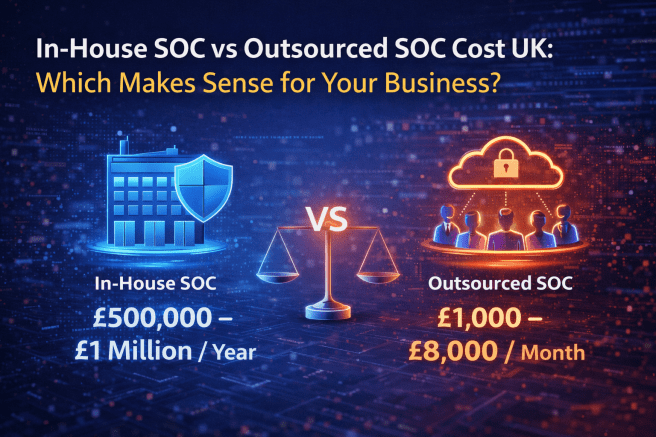
The in-house SOC vs outsourced SOC cost comparison for UK businesses comes down to one fundamental reality: building a Security Operations Centre internally costs between £500,000 and £1 million per year at minimum, while an outsourced SOC typically costs between £1,000 and £8,000 per month depending on scope and coverage level.
For most UK businesses with fewer than 500 staff, the maths consistently favours outsourcing. For larger enterprises with complex regulatory obligations and a mature internal security team, an in-house or hybrid model may be worth the investment. This guide breaks down exactly where those costs come from and what each model actually delivers.
What an In-House SOC Actually Costs in the UK
Building a functional, 24/7 in-house SOC requires three things that are all expensive in the UK market: people, technology, and time.
People costs
A minimum viable SOC requires at least 6 to 8 analysts to provide genuine 24/7 coverage across shifts, including cover for holidays, sick leave, and training. UK security analyst salaries range from £35,000 for Level 1 analysts to £70,000 or more for senior Level 3 analysts and SOC managers. Add employer National Insurance, pension contributions, and recruitment costs, and a realistic staffing bill for a small in-house SOC runs to £350,000 to £600,000 per year.
Technology costs
A SOC requires a SIEM platform for log aggregation and correlation, an EDR or XDR solution for endpoint visibility, a SOAR platform for automated response, and threat intelligence feeds. Enterprise-grade tooling for a mid-sized UK business typically costs £80,000 to £200,000 per year in licensing fees alone.
Infrastructure and facilities
Physical or cloud infrastructure, network connectivity, and the management overhead of maintaining the platform add a further £30,000 to £80,000 annually.
Total realistic annual cost: £500,000 to £1,000,000 or more
This does not include the 12 to 18 months it typically takes to move from standing start to a mature, operational SOC — a period during which you are spending without full capability in return.
What an Outsourced SOC (SOCaaS) Costs in the UK
An outsourced SOC, or Security Operations Centre as a Service, provides managed threat monitoring, detection, and response delivered by a specialist provider on a subscription basis.
| Business Size | Monthly Cost | What It Typically Includes |
| Small (under 50 users) | £1,000 to £3,000/month | 24/7 monitoring, endpoint detection, alerting, monthly reporting |
| Mid-market (50 to 200 users) | £3,000 to £6,000/month | Full SOC coverage, threat hunting, incident containment, compliance reporting |
| Mid-large (200 to 500 users) | £5,000 to £12,000/month | Dedicated analysts, SIEM management, IR support, custom reporting |
These costs are subscription-based and predictable. You are not paying for shift cover, recruitment, technology licensing, or infrastructure separately all of those are absorbed into the provider’s model.
Most UK providers price outsourced SOC services based on three variables: the number of endpoints or users monitored, the volume of log data ingested daily, and the depth of response capability included. Business hours monitoring costs significantly less than genuine 24/7 coverage with active containment capability.
Direct Cost Comparison
| Factor | In-House SOC | Outsourced SOC |
| Annual cost | £500,000 to £1,000,000+ | £12,000 to £96,000 |
| Time to operational | 12 to 18 months | 2 to 6 weeks |
| 24/7 coverage | Expensive and difficult to staff | Included at higher tiers |
| Recruitment and retention risk | High — analysts are scarce | None |
| Technology licensing | Separate and ongoing | Included |
| Scalability | Requires additional headcount | Immediate |
| Threat intelligence | Limited to internal capability | Continuously updated |
What the Cost Comparison Does Not Show
The financial comparison alone understates the gap between the two models for most UK SMEs.
The UK cyber security skills shortage is severe. Experienced SOC analysts are in high demand and frequently move between employers. An in-house SOC that loses two or three analysts in the same year faces significant gaps in coverage and capability at exactly the moment the market makes replacement difficult and expensive.
An outsourced SOC provider distributes this risk across their entire analyst team. Your coverage does not depend on any individual not handing in their notice.
Understanding whether a virtual CISO or a managed SOC better fits your current security maturity is an important question before committing to either model. A vCISO provides strategic direction and governance. A managed SOC provides operational monitoring and response. Growing UK businesses often need both but at different stages and in different configurations.
The Hybrid SOC Model
Many UK businesses at the 200 to 500 staff level adopt a hybrid approach: an internal security function handles daytime operations and business context, while an outsourced SOC covers evenings, weekends, and bank holidays.
This model is practical for organisations that have some internal security capability but cannot justify the full cost of round-the-clock internal staffing. It also allows the internal team to retain ownership of security decisions while offloading the operationally intensive monitoring work.
In all models, ensuring that a cyber incident response plan that meets UK regulations sits alongside your SOC model is not optional. The SOC detects and contains. The incident response plan governs how the organisation responds, communicates, and reports to the ICO and other regulators.
Choosing the Right Model for Your Business
For UK businesses with under 200 staff and no dedicated security team, an outsourced SOC delivers 24/7 coverage at a cost that is genuinely accessible and removes the need to hire, manage, and retain specialist analysts internally.
For businesses with 200 to 500 staff, a hybrid or co-managed model often provides the best balance of internal visibility and external capability.
For large enterprises with dedicated security teams, regulatory obligations that require named internal accountability, and the budget to sustain a full programme, an in-house SOC with outsourced specialist support for specific functions is justifiable.
Choosing the right cyber security consulting service for your organisation’s monitoring needs should begin with an honest assessment of your current visibility, your threat profile, and what a breach would cost you relative to the monitoring investment.
Frequently Asked Questions
What does an outsourced SOC cost in the UK?
UK outsourced SOC services typically cost £1,000 to £8,000 per month depending on organisation size, coverage hours, and service depth.
How much does building an in-house SOC cost?
A minimum viable in-house SOC costs £500,000 to £1,000,000 per year, covering staffing, technology, and infrastructure.
What is SOCaaS?
SOCaaS is Security Operations Centre as a Service, a managed subscription model providing 24/7 threat monitoring and response without building internal infrastructure.
Is an outsourced SOC as effective as an in-house one?
For most UK SMEs, yes. Outsourced providers offer broader threat intelligence, faster deployment, and consistent coverage without the staffing challenges of an internal team.
How quickly can an outsourced SOC be operational?
Most UK managed SOC providers can have monitoring active within 2 to 6 weeks, compared to 12 to 18 months to build an equivalent in-house capability.
Do I need a SOC if I already have endpoint protection?
Endpoint protection detects threats on devices. A SOC correlates signals across your entire environment, investigates alerts, and responds. They serve different and complementary functions.