
Supply Chain Cyber Risk: What UK Businesses Need to Know in 2026
- April 21, 2026
- Posted by: Gradeon
- Categories: Consulting, Cyber Security
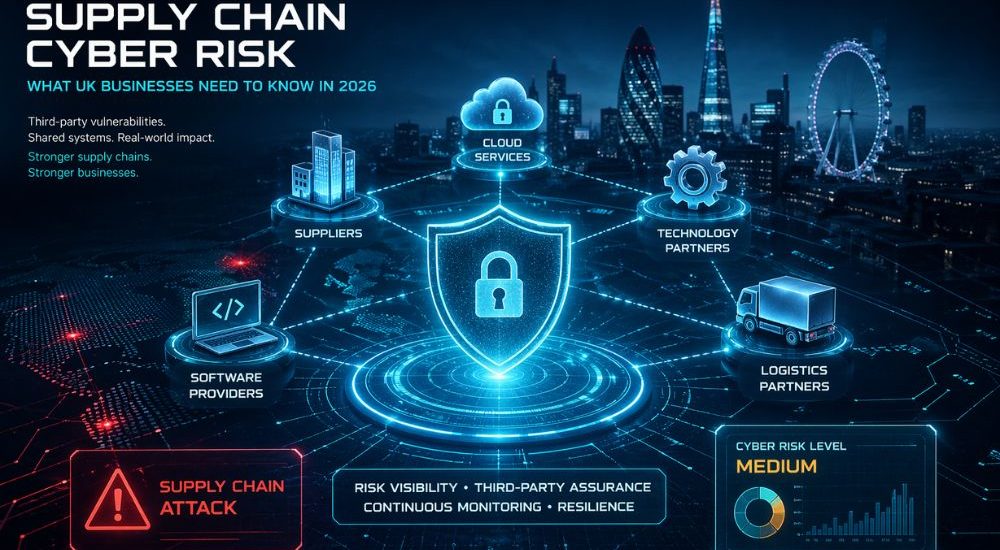
Supply chain cyber risk is one of the most significant and most underestimated threats facing UK businesses in 2026. It refers to the security vulnerabilities introduced into your organisation through the third-party suppliers, software providers, cloud services, and technology partners you rely on to operate.
The UK Government Cyber Security Breaches Survey 2025 found that only 14% of UK businesses formally review the cyber security risks posed by their immediate suppliers. That figure has barely moved in three years, despite supply chain attacks becoming one of the most consistently exploited attack vectors against organisations of all sizes.
Why Your Suppliers Are a Security Risk to Your Business
Understanding how cybersecurity risk enters your business through the supply chain starts with recognising that every supplier with access to your systems, your data, or your network is a potential entry point for an attacker.
This includes:
- Software-as-a-Service providers whose platforms your staff use daily
- Managed IT service providers with administrative access to your infrastructure
- Payment processors and financial technology partners
- Cloud hosting and storage providers
- Professional services firms with access to sensitive client data
- Logistics and operational technology providers in manufacturing or retail
Attackers target suppliers because smaller vendors typically have fewer security controls than the organisations they serve. Compromising a supplier’s system provides access to every organisation that vendor serves, often without triggering the security monitoring of the primary target.
The 2023 MOVEit attack, which affected NHS partners, financial institutions, and hundreds of other UK organisations through a vulnerability in a widely-used file transfer tool, demonstrated precisely this dynamic. The target organisations had strong internal security. Their supplier did not.
What UK Regulations Require from Third-Party Risk Management
Supply chain security is no longer just best practice. It is a formal compliance obligation under multiple UK and international frameworks.
UK GDPR requires organisations to conduct due diligence on any supplier acting as a data processor. If a supplier handles personal data on your behalf, you must have a written contract confirming their security obligations and you must verify that they are meeting them. A supplier breach that exposes your customers’ data is your reportable incident, not theirs.
Understanding how NIS2 and UK GDPR both place formal obligations on third-party risk management is increasingly relevant for UK organisations operating in or supplying the EU market. NIS2, which applies to essential and important entities across the EU and to their supply chains, explicitly requires organisations to assess and manage the security practices of their direct suppliers and service providers.
PCI DSS requires any organisation handling card payments to confirm that their payment service providers and technology partners maintain current PCI DSS compliance. Using a non-compliant provider does not transfer liability — it extends your compliance obligation.
ISO 27001:2022 includes specific controls around supplier relationships, covering information security requirements in contracts, monitoring of supplier service delivery, and managing changes to supplier services.
How to Assess Supply Chain Cyber Risk Practically
Most UK businesses know they should be assessing their suppliers but find the process unclear. These are the steps that deliver the most risk reduction in practice.
Step 1: Map your supplier landscape
List every supplier that has access to your systems, your data, or your network. Include SaaS platforms where staff log in with business credentials, any service provider with admin or privileged access, and any technology vendor whose software runs in your environment. Most businesses discover suppliers they had forgotten about during this exercise.
Step 2: Categorise by risk
Not every supplier carries the same risk. Prioritise suppliers based on two factors: the sensitivity of the data or access they have, and the criticality of the service they provide. A cloud provider hosting your financial data is a higher-risk supplier than a stationery company with no system access.
Step 3: Conduct due diligence on high-risk suppliers
For your highest-risk suppliers, formal due diligence is required. This means requesting evidence of their security certifications, reviewing their security policies, confirming their incident notification timelines, and verifying that their contracts with you include clear security obligations.
Ask for: Cyber Essentials or ISO 27001 certification, their most recent penetration test summary, evidence of staff security awareness training, and their breach notification process. A supplier that cannot provide these should be treated as a higher risk than one that can.
Step 4: Review contracts
Most supplier contracts do not contain adequate security requirements. Review your contracts with critical suppliers and confirm they include: required security standards, notification timelines if a breach affects your data, right-to-audit clauses, and liability provisions if their failure causes your loss.
Step 5: Monitor continuously
Supplier security posture changes. A supplier that was Cyber Essentials certified last year may not have renewed. A key contact who knew your security requirements may have left. Annual reviews at minimum, with more frequent checks for your highest-risk suppliers, ensure your assessments reflect current reality rather than a point-in-time snapshot.
What Weak Supplier Security Actually Costs UK Businesses
A supply chain breach is legally and financially your problem even when the technical failure was your supplier’s.
Under UK GDPR, if a supplier breach exposes your customers’ personal data, you are the data controller and you have 72 hours to notify the ICO. Fines, legal costs, and reputational damage land with your business regardless of where the technical failure originated.
Under PCI DSS, a confirmed cardholder data breach triggered through a supplier’s system results in a mandatory forensic investigation against your organisation. The investigation costs, fines, and potential suspension of card acceptance apply to you.
Implementing a robust third-party risk management process that satisfies both compliance and security requirements is not a separate project from your core security programme. It is a foundational part of it — one that the UK Government’s own data shows fewer than one in seven UK businesses has properly addressed.
Frequently Asked Questions
What is supply chain cyber risk?
It is the security risk your business inherits from third-party suppliers, vendors, or software providers who have access to your systems or data.
Are UK businesses legally responsible for their supplier’s security failures?
Yes, under UK GDPR and PCI DSS. If a supplier breach exposes your data, your business faces the regulatory and financial consequences.
How many UK businesses formally review their supplier security?
Only 14% of UK businesses formally review immediate supplier cyber risks, according to the UK Government Cyber Security Breaches Survey 2025.
What should a supplier security assessment include?
Security certifications, breach notification processes, contractual security obligations, evidence of staff training, and penetration testing evidence for high-risk suppliers.
Does ISO 27001 cover supply chain security?
Yes. ISO 27001:2022 includes specific controls requiring organisations to manage supplier security obligations, monitor delivery, and address changes to supplier services.
How often should UK businesses review their supplier security?
At minimum annually for all suppliers and more frequently for those with privileged access or who handle sensitive data on your behalf.