
Cyber Essentials 2026 Update — What Has Changed
- May 12, 2026
- Posted by: Gradeon
- Category: Cyber Security
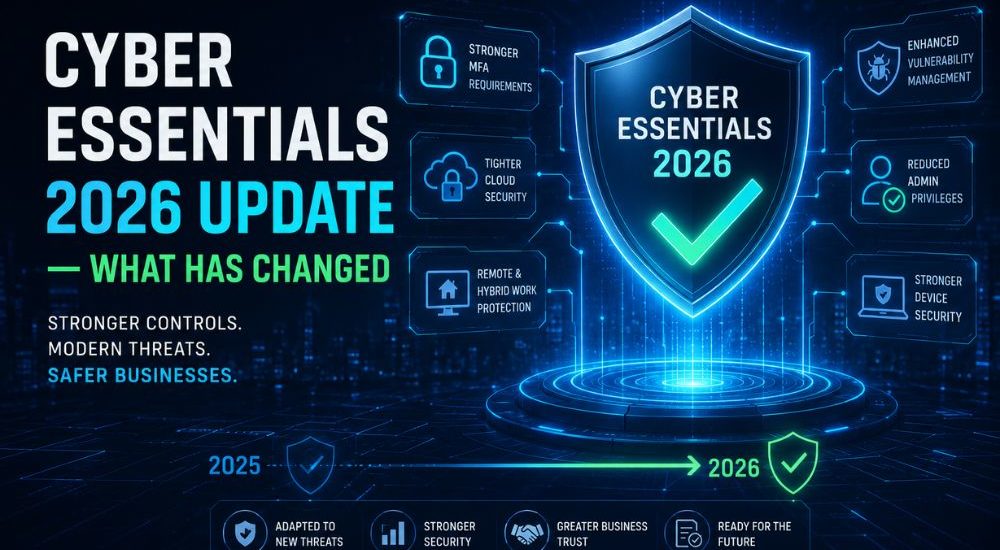
Cyber threats are evolving faster than ever, and UK businesses are under increasing pressure to strengthen their cyber security posture. In response to rising ransomware attacks, phishing campaigns, and supply chain breaches, the Cyber Essentials scheme has continued to evolve in 2026.
For organisations already certified, or businesses planning to achieve certification this year, understanding the latest updates is important.
The 2026 Cyber Essentials changes are not about making compliance harder. Instead, the updates focus on improving real-world security, reducing common attack paths, and aligning with how modern businesses actually operate today.
From stronger multi-factor authentication expectations to tighter cloud security requirements, the latest changes reflect the growing sophistication of cyber threats targeting UK organisations.
This guide explains what changed in Cyber Essentials 2026, why the updates matter, and how businesses can prepare.
Why Cyber Essentials Continues to Evolve
Cyber Essentials was originally introduced to help organisations defend against common internet-based attacks.
At the time, many businesses still relied heavily on on-premise infrastructure and office-based work environments.
Today, the situation looks very different.
Modern organisations now operate using:
- Remote and hybrid work environments
- Cloud-first infrastructure
- SaaS platforms
- Mobile devices
- Third-party collaboration tools
- Distributed endpoints
At the same time, attackers have become more advanced.
According to recent UK government cyber breach data, phishing remains the most common attack method affecting UK businesses, while ransomware incidents continue to rise year after year.
The Cyber Essentials 2026 updates are designed to address these changing risks more effectively.
The Biggest Cyber Essentials 2026 Changes
1. Stronger Focus on Multi-Factor Authentication (MFA)
One of the most important updates in 2026 is the increased emphasis on MFA implementation.
Cyber Essentials already recommended MFA for critical systems, but the updated guidance now places greater importance on:
- Cloud applications
- Email accounts
- Administrator accounts
- Remote access systems
- Microsoft 365 and Google Workspace environments
Businesses relying only on passwords are increasingly vulnerable to phishing and credential theft.
Microsoft has repeatedly reported that MFA can block the vast majority of automated account compromise attempts.
As a result, organisations pursuing certification in 2026 are expected to demonstrate stronger MFA adoption across their environment.
2. Tighter Requirements for Cloud Security
Cloud infrastructure now plays a major role in Cyber Essentials assessments.
The 2026 updates place greater attention on:
- Secure cloud configurations
- Access control management
- Admin privilege separation
- Cloud application security
- User identity protection
This is especially relevant for businesses using:
- Microsoft 365
- Google Workspace
- AWS
- Azure
- SaaS collaboration tools
Misconfigured cloud environments remain one of the leading causes of data exposure incidents globally.
The updated guidance aims to reduce these risks by encouraging stronger visibility and access governance.
3. Better Coverage for Remote and Hybrid Work
Remote work is no longer treated as a temporary arrangement.
Cyber Essentials 2026 now assumes that employees may regularly work from:
- Home networks
- Shared workspaces
- Mobile devices
- Public internet connections
Because of this shift, assessors now pay closer attention to:
- Device management
- Endpoint security
- Secure VPN usage
- Patch management consistency
- Remote access controls
Businesses with unmanaged remote devices may struggle to meet compliance requirements if security controls are inconsistent.
4. Increased Emphasis on Vulnerability Management
Patch management has always been part of Cyber Essentials, but the 2026 guidance places even stronger focus on vulnerability remediation speed.
Organisations are expected to:
- Identify vulnerabilities quickly
- Apply security updates consistently
- Remove unsupported software
- Reduce exposure windows
Attackers frequently exploit known vulnerabilities within days of public disclosure.
This makes delayed patching one of the biggest security risks for modern organisations.
Businesses pursuing Cyber Essentials Plus may face stricter scrutiny around update management processes during technical assessment.
5. More Attention on Administrative Privileges
Excessive administrator access remains a major contributor to ransomware spread and internal compromise.
The 2026 updates encourage organisations to adopt:
- Least privilege access
- Separate admin accounts
- Role-based access control
- Limited administrator exposure
Many businesses still provide employees with unnecessary local administrator rights, which significantly increases risk during malware infections.
Reducing privilege misuse has become a larger focus area in Cyber Essentials assessments.
6. Stronger Device Security Expectations
Modern endpoints are now a primary attack target.
The updated guidance reinforces expectations around:
- Device encryption
- Screen lock policies
- Antivirus and EDR protection
- Secure device configuration
- Mobile device security
Businesses using BYOD (Bring Your Own Device) models may also need clearer visibility into device compliance and security controls.
What Has Not Changed?
While the updates strengthen certain requirements, the core Cyber Essentials framework remains the same.
The five technical control themes are still:
- Firewalls
- Secure configuration
- User access control
- Malware protection
- Security update management
The goal also remains unchanged:
Helping organisations defend against common cyber attacks using practical, achievable controls.
Cyber Essentials is still considered a baseline certification, not a replacement for a full cyber security strategy.
How the 2026 Changes Affect SMEs
Many small businesses worry that Cyber Essentials updates will make certification significantly harder or more expensive.
In reality, most of the new focus areas reflect security practices businesses should already be implementing.
For SMEs, the biggest adjustments are likely to involve:
- Enabling MFA consistently
- Improving patch management
- Securing remote devices
- Reviewing administrator privileges
- Strengthening cloud security settings
The changes are more about operational discipline than expensive technology investments.
Cyber Essentials Plus in 2026
The 2026 updates are particularly important for organisations pursuing Cyber Essentials Plus.
Unlike standard Cyber Essentials certification, Plus includes independent technical verification.
Assessors may now place greater emphasis on:
- Cloud account security
- MFA enforcement
- Remote device compliance
- Vulnerability remediation
- Endpoint protection effectiveness
This means businesses should prepare more thoroughly before assessment.
Many organisations now conduct internal audits or vulnerability scans before attempting Cyber Essentials Plus certification.
Why These Updates Matter for UK Businesses
Cyber security is no longer just an IT issue.
It directly affects:
- Customer trust
- Regulatory compliance
- Cyber insurance eligibility
- Procurement opportunities
- Operational resilience
Increasingly, businesses are being evaluated on their ability to demonstrate practical security controls, not just written policies.
The Cyber Essentials 2026 updates reflect this shift toward measurable operational security.
For many organisations, certification is becoming a business requirement rather than a technical checkbox.
Common Mistakes Businesses Make Before Certification
Treating Cyber Essentials as a One-Time Exercise
Security controls must remain active year-round, not only during assessment periods.
Ignoring Cloud Misconfigurations
Many organisations focus heavily on endpoint devices while overlooking Microsoft 365 or cloud admin settings.
Delaying MFA Rollout
Partial MFA implementation may no longer be sufficient in higher-risk environments.
Failing to Remove Old Devices
Unmanaged or unsupported devices can create major compliance gaps.
How Businesses Can Prepare for Cyber Essentials 2026
Here are practical steps organisations should take before certification:
Review MFA Deployment
Ensure MFA is enabled across critical systems, email platforms, and admin accounts.
Audit Administrator Privileges
Remove unnecessary admin access wherever possible.
Check Patch Management Processes
Verify operating systems and applications are updated consistently.
Review Cloud Security Settings
Audit Microsoft 365, Google Workspace, and other SaaS platforms for security misconfigurations.
Assess Remote Devices
Ensure hybrid and remote devices follow the same security standards as office systems.
Conduct Internal Vulnerability Reviews
Identify weaknesses before formal assessment begins.
Businesses planning broader security improvements may also benefit from reviewing this guide on cyber security consulting services from Gradeon.
Cyber Essentials in 2026 Is About Real Security
The biggest takeaway from the 2026 updates is simple:
Cyber Essentials is moving further away from “paper compliance” and closer toward practical operational security.
The scheme now reflects how businesses actually work in modern environments, including cloud platforms, hybrid teams, and distributed devices.
For UK organisations, that is ultimately a positive shift.
Businesses that proactively improve MFA, vulnerability management, cloud security, and endpoint protection will not only improve certification readiness but also reduce real-world cyber risk significantly.
And in today’s threat landscape, that matters more than ever.
Frequently Asked Questions
What changed in Cyber Essentials 2026?
The Cyber Essentials 2026 update introduced stronger requirements around multi-factor authentication (MFA), cloud security, remote working protections, vulnerability management, and administrator access controls to better address modern cyber threats.
Is MFA now mandatory for Cyber Essentials certification?
Cyber Essentials 2026 places much greater emphasis on MFA, especially for cloud platforms, administrator accounts, remote access systems, and email services like Microsoft 365 and Google Workspace.
Do the 2026 updates affect small businesses?
Yes, but mainly in practical areas such as patch management, MFA adoption, remote device security, and cloud configuration. Most SMEs can meet the updated requirements without major infrastructure changes.
Has Cyber Essentials Plus changed in 2026?
Yes. Cyber Essentials Plus assessments now place greater focus on cloud security, endpoint protection, vulnerability remediation, and remote working environments during technical verification.
Does Cyber Essentials 2026 include cloud security requirements?
Yes. The updated framework gives much more attention to cloud platforms, including secure configurations, user access management, administrator controls, and SaaS application security.
Why were the Cyber Essentials 2026 updates introduced?
The updates were introduced to address evolving cyber threats, including ransomware, phishing, cloud misconfigurations, and hybrid working risks affecting UK businesses.