
Cyber Essentials Plus vs Basic — What Is the Difference?
- May 20, 2026
- Posted by: Gradeon
- Category: Consulting
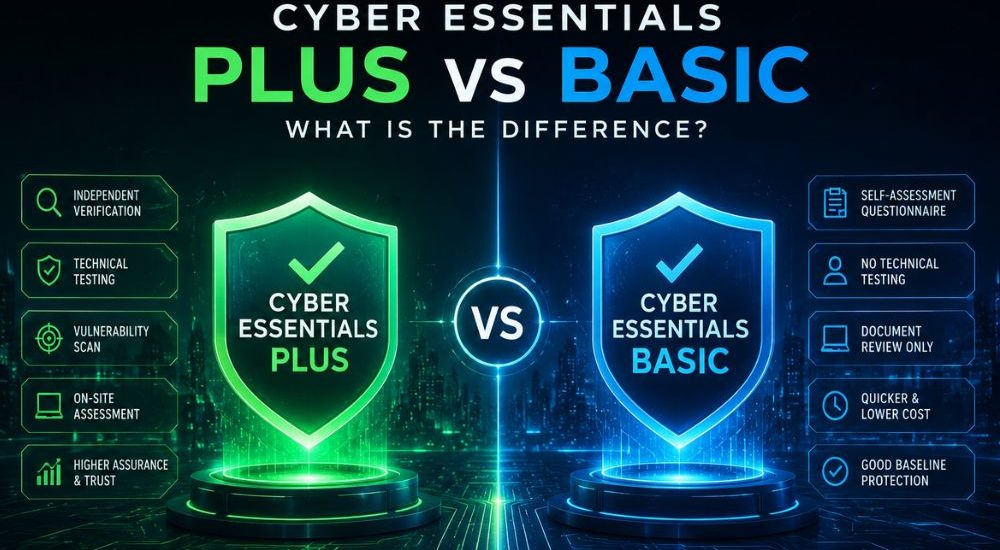
Cyber attacks are no longer a problem only for large enterprises. In the UK, ransomware, phishing, and credential theft now affect businesses of every size, from small accountancy firms to growing ecommerce brands.
According to the UK Government’s Cyber Security Breaches Survey 2025, around half of UK businesses experienced some form of cyber security breach or attack in the previous 12 months. Phishing remained the most common attack method, while ransomware incidents continued to increase year over year.
That is exactly why more organisations are turning to the UK Government-backed Cyber Essentials scheme.
But one question appears repeatedly:
Should you choose Cyber Essentials Basic or Cyber Essentials Plus?
At first glance, they sound similar. Both certifications focus on protecting businesses from common cyber threats. Both are recognised across the UK. Both help improve trust with clients, insurers, and supply chain partners.
However, the difference between them is significant.
One is a self-assessment certification.
The other is independently verified through technical testing.
This guide explains the real differences between Cyber Essentials and Cyber Essentials Plus, including costs, testing methods, compliance value, and which option makes sense for your business in 2026.
What Is Cyber Essentials?
National Cyber Security Centre-backed Cyber Essentials is a UK cyber security certification scheme designed to help organisations defend against the most common cyber attacks.
The framework focuses on five core security controls:
- Firewalls and internet gateways
- Secure configuration
- User access control
- Malware protection
- Security update management
The goal is straightforward:
Reduce the likelihood of opportunistic cyber attacks by implementing basic but effective security controls.
Cyber Essentials certification has become increasingly important for:
- Government suppliers
- SMEs bidding for contracts
- Businesses seeking cyber insurance
- Organisations handling customer data
- Companies working toward broader compliance frameworks like ISO 27001
Many UK public sector contracts now require Cyber Essentials certification as a minimum baseline.
What Is Cyber Essentials Basic?
Cyber Essentials Basic is the entry-level certification.
It works through a self-assessment questionnaire completed by your organisation.
You answer questions about your security controls, including:
- Device configuration
- Password policies
- MFA implementation
- Patch management
- Firewall protections
- User permissions
An external certification body reviews the answers and determines whether your organisation meets the required standard.
Importantly:
There is no hands-on technical testing during Cyber Essentials Basic.
The certification relies on truthful and accurate responses from your business.
What Does Cyber Essentials Basic Include?
Typical areas reviewed include:
| Security Area | What Is Checked |
| Password security | Strong password policies |
| MFA | Multi-factor authentication deployment |
| Device security | Secure laptop and desktop configurations |
| Patch management | Timely operating system and software updates |
| Malware protection | Antivirus or endpoint security |
| Access control | User privilege management |
| Firewall protection | Network boundary security |
For many small businesses, this creates a solid security foundation without major cost or operational disruption.
What Is Cyber Essentials Plus?
Cyber Essentials Plus includes everything in the Basic certification but adds an important extra layer:
Independent technical verification
Instead of relying solely on self-assessment answers, Cyber Essentials Plus involves a qualified assessor actively testing your systems.
This usually includes:
- Vulnerability checks
- Device sampling
- MFA validation
- Malware protection testing
- External vulnerability scans
- Internal configuration reviews
In simple terms:
Cyber Essentials Plus proves your controls are not just documented but actually working.
The Biggest Difference Between Basic and Plus
The easiest way to understand the difference is this:
| Certification | Validation Method |
| Cyber Essentials Basic | Self-assessment questionnaire |
| Cyber Essentials Plus | Independent technical audit |
That single distinction changes the level of assurance significantly.
Cyber Essentials Basic says:
“We believe these controls are in place.”
Cyber Essentials Plus says:
“An independent assessor tested these controls and confirmed they work.”
For clients, insurers, and regulators, that difference matters.
Cyber Essentials Plus vs Basic — Full Comparison
| Feature | Cyber Essentials Basic | Cyber Essentials Plus |
| Self-assessment | Yes | Yes |
| Independent audit | No | Yes |
| Technical testing | No | Yes |
| Vulnerability scanning | Limited | Extensive |
| Device testing | No | Yes |
| External verification | Questionnaire review only | Hands-on assessment |
| Security assurance level | Moderate | High |
| Suitable for government contracts | Often | Strongly preferred |
| Cyber insurance value | Good | Better |
| Typical UK cost | £400 to £500 | £1,500 to £3,500 |
| Time required | Fast | Longer assessment process |
Current UK market pricing aligns with wider cyber security cost benchmarks published across the industry.
Why Cyber Essentials Plus Matters More in 2026
Cyber threats have become more sophisticated.
Attackers no longer target only enterprise organisations. SMEs are now prime targets because they often lack mature security controls.
This shift has changed how clients and insurers evaluate suppliers.
Increasingly, businesses are asking:
- Can you prove your controls work?
- Have your systems been independently verified?
- Do you have externally validated cyber security assurance?
Cyber Essentials Basic helps demonstrate intent.
Cyber Essentials Plus demonstrates evidence.
That distinction is becoming more important every year.
Real Business Impact of Cyber Essentials Plus
1. Stronger Client Trust
Many procurement teams now prefer suppliers with Cyber Essentials Plus because it provides higher confidence in operational security.
This is especially common in:
- Financial services
- SaaS
- Legal services
- Healthcare
- Education
- Government supply chains
2. Better Cyber Insurance Positioning
Insurers increasingly evaluate security maturity before offering coverage.
Organisations with Cyber Essentials Plus often appear lower risk because their controls have undergone technical validation.
Some insurers may even require stronger evidence than self-assessment certifications alone.
3. Improved Internal Security Hygiene
One overlooked advantage of Cyber Essentials Plus is operational discipline.
Because technical testing is involved, organisations become more proactive about:
- Patch management
- MFA deployment
- Endpoint security
- User access control
- Device management
This improves real-world resilience, not just compliance.
4. Competitive Advantage in Tenders
Many UK businesses now use cyber security certifications during vendor evaluation.
Having Cyber Essentials Plus can strengthen your position against competitors that only hold Basic certification.
For regulated industries, it can become a deciding factor.
Does Cyber Essentials Plus Include Penetration Testing?
No.
This is one of the most misunderstood areas.
Cyber Essentials Plus is not a penetration test.
It verifies baseline security controls but does not simulate advanced attacker behaviour.
A penetration test goes significantly deeper by actively attempting to exploit vulnerabilities and demonstrate real-world attack paths.
Typical UK penetration testing costs range from:
- £1,500 to £5,000 for external testing
- £2,000 to £8,000 for web application testing
depending on scope and complexity.
Businesses handling sensitive data or compliance obligations often combine:
- Cyber Essentials Plus
- Annual penetration testing
- Vulnerability scanning
- Security awareness training
for a more mature security posture.
If you are exploring penetration testing alongside certification, this guide on penetration testing cost in the UK from Gradeon provides realistic pricing expectations for UK businesses.
Which Businesses Should Choose Cyber Essentials Basic?
Cyber Essentials Basic is usually suitable for:
- Small businesses with limited budgets
- Early-stage startups
- Organisations seeking baseline certification
- Businesses needing quick compliance
- Companies beginning their cyber security journey
It is particularly valuable when:
- You need a fast certification
- Client requirements are minimal
- Your infrastructure is relatively simple
For many SMEs, Basic certification is still a meaningful improvement over having no recognised security framework at all.
Which Businesses Should Choose Cyber Essentials Plus?
Cyber Essentials Plus is better suited for:
- Businesses handling sensitive customer data
- Government suppliers
- SaaS providers
- Managed service providers
- Financial and legal firms
- Healthcare organisations
- Companies with compliance obligations
- Businesses pursuing enterprise contracts
It is also ideal for organisations wanting stronger market credibility.
If your clients ask security questionnaires regularly, Cyber Essentials Plus usually carries more weight.
Is Cyber Essentials Plus Worth the Extra Cost?
For many businesses, yes.
The price difference between Basic and Plus is relatively small compared to the potential cost of a cyber incident.
UK Government data shows that businesses suffering material cyber incidents face average losses exceeding £8,000, while medium and large organisations often experience substantially higher operational impact.
Compared to those risks, the additional assurance from Cyber Essentials Plus is often a worthwhile investment.
Especially when it helps:
- Win contracts
- Improve trust
- Strengthen insurance positioning
- Reduce attack exposure
- Improve compliance readiness
Common Mistakes Businesses Make
Treating Certification as “Complete Security”
Cyber Essentials is a baseline framework, not a full cyber security strategy.
Certification alone does not eliminate risk.
Ignoring Staff Training
Human error remains one of the biggest attack vectors.
Even businesses with strong technical controls remain vulnerable to phishing and credential theft without user awareness training.
Delaying Patch Management
Many organisations fail Cyber Essentials Plus because systems are not patched consistently.
Security updates remain one of the simplest but most critical protections.
Choosing Based Only on Cost
The cheapest certification option is not always the most valuable long term.
Businesses should evaluate:
- Client expectations
- Insurance requirements
- Contract opportunities
- Risk exposure
- Operational maturity
before deciding.
The Right Choice Depends on Your Business Needs
Cyber Essentials Basic and Cyber Essentials Plus both improve cyber security posture, but they serve different levels of assurance.
Cyber Essentials Basic provides a strong starting point through self-assessment.
Cyber Essentials Plus goes further by independently verifying that your controls actually work in practice.
For many UK businesses in 2026, that additional verification is becoming increasingly important.
As cyber threats rise and procurement standards tighten, independently validated security controls carry more weight with clients, insurers, and regulators alike.
If your organisation wants stronger trust, better compliance positioning, and greater operational assurance, Cyber Essentials Plus is often the smarter long-term investment.
For businesses evaluating broader cyber security strategy, budgeting, or compliance planning, these additional resources from Gradeon and Gradeon Consulting Guide may also help.
Frequently Asked Questions
What is the main difference between Cyber Essentials and Cyber Essentials Plus?
The main difference is the level of verification. Cyber Essentials is a self-assessment certification, while Cyber Essentials Plus includes independent technical testing to verify that security controls are properly implemented and working effectively.
Is Cyber Essentials Plus mandatory for UK businesses?
No, Cyber Essentials Plus is not legally mandatory for most businesses. However, many government contracts, enterprise supply chains, and regulated industries increasingly prefer or require it as part of vendor security assessments.
How much does Cyber Essentials Plus cost in the UK?
Cyber Essentials Plus typically costs between £1,500 and £3,500 in the UK, depending on the size of the organisation, number of devices, and complexity of the IT environment.
Does Cyber Essentials Plus include penetration testing?
No. Cyber Essentials Plus is not a penetration test. It validates core security controls through technical assessment but does not simulate advanced attacks or attempt to exploit vulnerabilities like a full penetration test would.
Can a small business get Cyber Essentials Plus certification?
Yes. Small businesses can absolutely achieve Cyber Essentials Plus certification. In fact, many SMEs use it to improve customer trust, strengthen cyber security posture, and qualify for larger contract opportunities.
Which is better for compliance: Cyber Essentials Basic or Plus?
Cyber Essentials Plus generally provides stronger compliance value because it includes independently verified technical testing. It is often viewed as more credible by clients, insurers, and procurement teams.