
SOC as a Service UK: What It Is and Whether Your Business Needs It
- May 15, 2026
- Posted by: Gradeon
- Category: Compliance
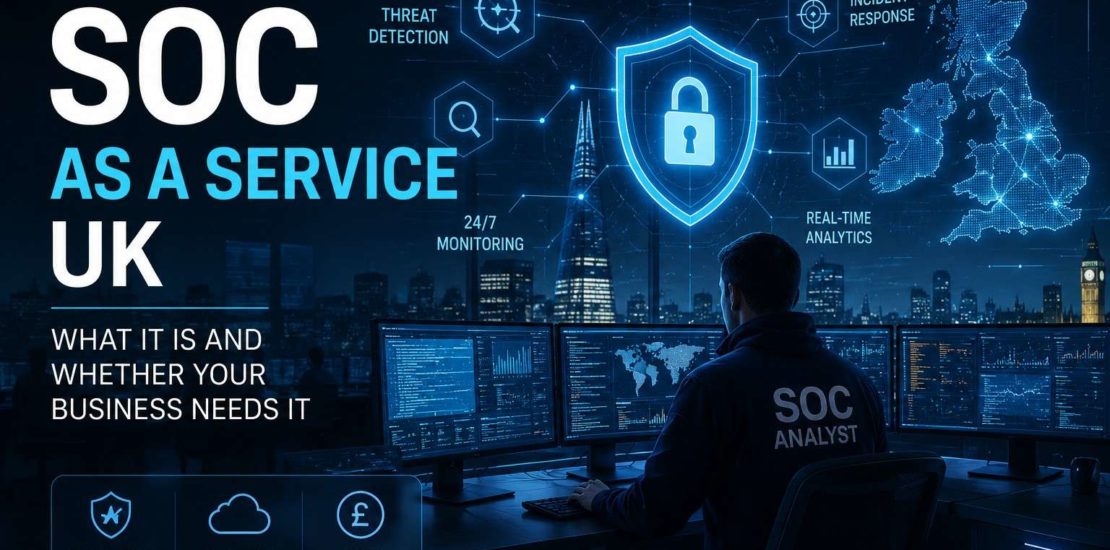
SOC as a Service (SOCaaS) is an outsourced security operations centre delivered as a subscription. It gives UK businesses 24/7 threat monitoring, detection, and incident response without the cost or complexity of building and staffing an in-house security team.
For most UK businesses with fewer than 500 staff, SOCaaS is the only practical route to round-the-clock security coverage. The alternative, an in-house SOC, costs between £500,000 and £1 million per year before tooling. SOCaaS delivers comparable capability for a fraction of that investment.
What a SOC Actually Does
A Security Operations Centre is the function responsible for monitoring your environment continuously, identifying threats before they cause damage, and responding when something goes wrong.
It brings together three components:
- People — trained security analysts who review alerts, investigate incidents, and make response decisions
- Technology — SIEM platforms for log aggregation, EDR and XDR for endpoint visibility, and SOAR for automated response
- Process — defined playbooks that determine how each type of incident is handled, escalated, and resolved
Without all three working together, you have partial visibility, not real security operations.
What SOC as a Service Includes
A UK SOCaaS provider delivers these capabilities as a managed subscription:
24/7 monitoring covers your endpoints, network, cloud environments, and identity platform continuously. Threats are detected at any hour, not just during business hours. Most UK cyber attacks occur outside working hours precisely because attackers know internal teams are not watching.
Threat detection and triage means every alert generated by your environment is reviewed by a human analyst. Automated tools generate high volumes of alerts, many of which are false positives. SOC analysts filter noise, prioritise genuine threats, and escalate only what requires action.
Incident response is the operational response when a real threat is confirmed. The SOC team contains the threat, isolates affected systems, and coordinates remediation. Response time is defined by the provider’s SLA — most UK providers target 15 to 30 minutes for critical incidents.
Threat intelligence keeps detection current. SOC providers maintain feeds of the latest attacker tactics, techniques, and procedures. This allows them to detect emerging threats before standard signature-based tools identify them.
Compliance reporting generates the audit evidence your compliance frameworks require. For ISO 27001, PCI DSS, and NIS2, documented monitoring activity and incident logs are a required control. A SOCaaS provider produces these reports automatically.
How SOC as a Service Works in Practice
Onboarding typically takes 2 to 6 weeks. The provider connects their SIEM to your environment, ingesting log data from your endpoints, firewalls, cloud services, identity platforms, and network devices.
Alert thresholds and detection rules are tuned to your specific environment during this period. A new SOC deployment without tuning generates excessive false positives. Good providers invest time in calibrating detection before declaring the service fully operational.
Once live, the SOC monitors your environment continuously. When an alert fires, an analyst reviews it, determines whether it is a genuine threat, and either closes it as a false positive or escalates it according to your defined playbook.
You receive regular reporting, typically monthly, covering threats detected, incidents responded to, false positive rates, and your overall security posture trend.
SOC as a Service and UK Compliance
This is the angle most UK businesses miss when evaluating SOCaaS.
SOCaaS does not just improve your security posture. It directly supports your compliance obligations under multiple frameworks.
ISO 27001 requires continuous monitoring of security events under Annex A controls. A SOCaaS provider delivers documented evidence of that monitoring activity.
PCI DSS Requirement 10 mandates logging and monitoring of all access to cardholder data environments. SOCaaS covers this requirement with automated log collection and analyst review.
NIS2 requires essential and important entities to implement measures for detecting and managing incidents. A SOCaaS provider satisfies the operational monitoring requirement of Article 21.
UK GDPR requires appropriate technical measures to protect personal data. Continuous monitoring is one of the most defensible technical measures you can demonstrate to the ICO following a breach.
Understanding the cost difference between building an in-house SOC and using a SOC as a Service provider shows why outsourcing consistently makes financial sense for UK organisations at every level except large enterprise.
SOCaaS vs MDR: Understanding the Difference
Many UK providers use SOCaaS and Managed Detection and Response (MDR) interchangeably. There is a practical distinction worth understanding.
MDR focuses specifically on threat detection and response outcomes. It is the service delivered. SOCaaS is the operational model that delivers it. In practice, most MDR services are delivered through a SOC.
For UK businesses evaluating providers, focus on outcomes rather than terminology. Ask specifically what is monitored, how quickly incidents are responded to, what the escalation process looks like, and what compliance evidence is produced. The label matters less than the answers to those questions.
What SOCaaS Does Not Replace
SOCaaS is an operational service. It monitors, detects, and responds. It does not set your security strategy or govern your risk programme.
A tested cyber incident response plan that works alongside your SOC as a Service provider is essential. The SOC detects the incident and initiates containment. Your incident response plan governs how your organisation communicates internally, notifies regulators, manages client communications, and recovers from the event. One does not replace the other.
Similarly, how a virtual CISO provides strategic oversight while a SOC as a Service handles operational monitoring represents the most effective combined model for UK businesses that need both governance and operational coverage. The vCISO owns the strategy, the compliance programme, and board reporting. The SOCaaS provider owns continuous monitoring and first response.
Frequently Asked Questions
What is SOC as a Service?
An outsourced security operations centre delivering 24/7 threat monitoring, detection, and incident response as a subscription, without building an in-house team.
How much does SOC as a Service cost in the UK?
UK SOCaaS typically costs £1,000 to £8,000 per month depending on organisation size, number of endpoints monitored, and coverage level.
Does a managed SOC replace my IT team?
No. A SOC handles security monitoring and incident response. Your IT team manages infrastructure, systems, and day-to-day operations. They work in parallel.
How quickly can a SOCaaS provider be operational?
Most UK providers complete onboarding and go live within 2 to 6 weeks depending on the complexity of your environment and the number of log sources integrated.
Does SOCaaS satisfy ISO 27001 monitoring requirements?
Yes. SOCaaS delivers the continuous monitoring, log management, and documented incident response activity that ISO 27001 Annex A controls require.
What is the difference between a SOC and a SIEM?
A SIEM is a technology platform that collects and correlates security event data. A SOC is the team and process that operates the SIEM and acts on what it finds.