
Third-Party Vendor Security: A Practical Guide for UK Businesses
- April 22, 2026
- Posted by: Gradeon
- Category: Cyber Security
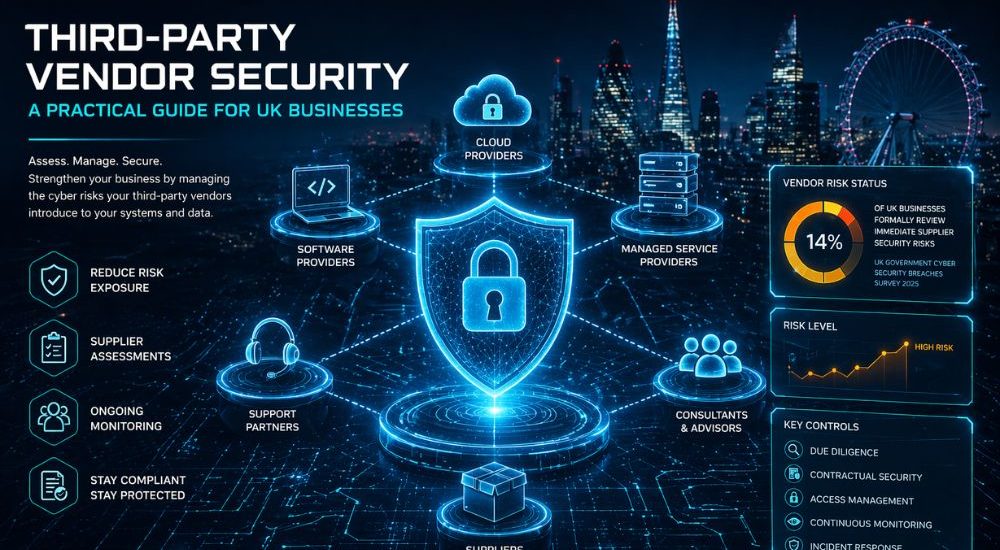
Third-party vendor security refers to the process of assessing and managing the cyber security risks introduced into your organisation by the external suppliers, software providers, and service partners you rely on. It is one of the most consistently underaddressed areas of UK business security, and one of the most frequently exploited by attackers.
The UK Government Cyber Security Breaches Survey 2025 confirmed that only 14% of UK businesses formally review the security of their immediate suppliers. For the other 86%, vendors with access to their systems, data, or network represent an unmanaged risk sitting outside their security perimeter but inside their compliance obligations.
Why Vendor Security Is Your Legal Responsibility, Not Just Good Practice
Many UK businesses treat vendor security as an optional extra. UK law and compliance frameworks treat it as a mandatory obligation.
UK GDPR requires any organisation sharing personal data with a third-party processor to conduct due diligence before engaging that supplier and to maintain a written contract confirming the supplier’s security obligations. If a vendor is breached and your customers’ data is exposed, the ICO will investigate your organisation as the data controller. Insufficient vendor due diligence is a finding, not an excuse.
ISO 27001:2022 includes specific controls covering supplier relationships under Annex A. These require organisations to agree information security requirements with suppliers before access is granted, monitor supplier service delivery against those requirements, and manage changes to supplier arrangements.
PCI DSS requires organisations processing card payments to confirm that any vendor involved in their payment environment maintains current compliance. A vendor’s non-compliance can directly affect your own PCI DSS status.
Understanding the broader supply chain cyber risks UK businesses face in 2026 is the starting point. Managing those risks at the individual vendor level is where compliance is either met or missed.
How to Build a Vendor Security Assessment Process
A vendor security assessment process does not need to be complex, but it does need to be consistent and documented. These are the five components that make it work.
1. Vendor inventory and classification
Before you can assess vendors, you need to know who they are. Build a complete list of every supplier with access to your systems, your data, or your network. This includes SaaS platforms your staff use with business credentials, managed IT providers, cloud hosting and storage services, payment processors, and professional services firms handling client data.
Once listed, classify each vendor by risk level. Vendors with privileged access or access to sensitive personal data are high risk. Vendors providing non-critical services with no data access are low risk. Concentrate your assessment effort on high and medium risk suppliers.
2. Pre-engagement due diligence
Before granting any new vendor access to your systems or data, conduct a security review. The minimum you should confirm for any high-risk vendor is:
- Current security certification — Cyber Essentials, ISO 27001, SOC 2, or equivalent
- How they encrypt data at rest and in transit
- Their breach notification timescales — under UK GDPR you need to know within 24 to 48 hours to meet your own 72-hour ICO notification obligation
- Their approach to access management — specifically whether their own staff follow least-privilege principles
- Evidence of recent penetration testing — at minimum within the last 12 months
A vendor that cannot answer these questions should be treated as higher risk than one that can, regardless of their brand recognition or market position.
3. Contractual security requirements
Most standard supplier contracts do not contain adequate security provisions. For any vendor handling personal data or accessing your systems, your contract should include:
- Specific security standards the vendor must maintain
- Incident notification timescales aligned to your regulatory obligations
- Right-to-audit clause allowing you to verify compliance
- Data handling and retention requirements
- Liability provisions if vendor failure causes your loss
These provisions are not adversarial. Reputable vendors accept them. A vendor that refuses reasonable security contractual requirements is giving you useful information about their security culture.
4. Ongoing monitoring and annual review
A one-time assessment at onboarding is insufficient. Vendor security posture changes over time. Certifications lapse. Key security contacts leave. New vulnerabilities emerge in platforms you rely on.
Set a review schedule for each vendor tier. High-risk vendors should be formally reviewed annually, with continuous monitoring for breach notifications or certification lapses. Medium-risk vendors should be reviewed every 12 to 18 months. All vendors should be reviewed immediately following any known breach, change in ownership, or significant change in the services they provide.
5. Documented evidence
Every assessment, review, and contractual provision should be documented. When the ICO investigates a breach involving a vendor, or when an ISO 27001 auditor reviews your supplier management controls, documented evidence of your due diligence process is what determines whether you meet the standard. Undocumented activity is treated as no activity.
Connecting Vendor Security to Your Wider Compliance Programme
Vendor security does not sit in isolation. It is a component of your overall information security management programme and connects directly to your incident response planning, your data protection obligations, and your compliance certifications.
Implementing a robust third-party risk management process across your vendor portfolio is most effective when it is embedded into your procurement workflow rather than added as a separate exercise after vendors are already in place. Businesses that require security assessments as a condition of onboarding consistently have fewer vendor-related incidents than those that audit retrospectively.
How NIS2 changes director-level responsibilities for vendor security oversight is particularly relevant for UK organisations supplying EU entities or operating in essential sectors. Directors are now explicitly accountable for supply chain security decisions under NIS2, mirroring the trajectory of UK regulation under the Cyber Security and Resilience Bill.
Frequently Asked Questions
What is third-party vendor security?
It is the process of assessing and managing cyber security risks introduced by external suppliers, software providers, and service partners who have access to your systems or data.
Are UK businesses legally responsible for their vendors’ security failures?
Yes, under UK GDPR, if a vendor breaches personal data you shared with them, your organisation faces regulatory scrutiny for the adequacy of your due diligence.
What security certifications should I ask vendors to hold?
Cyber Essentials is the UK baseline. ISO 27001 or SOC 2 demonstrate more mature security programmes and are increasingly required by enterprise clients.
How often should vendor security assessments be repeated?
Assess high-risk vendors annually. Review all vendors following any breach, change in ownership, or significant service change.
What should a vendor security contract clause include?
Required security standards, breach notification timescales, right-to-audit provisions, data handling requirements, and liability provisions for security failures.
Can a vendor refuse to complete a security assessment?
They can, but refusal is a significant red flag. Any reputable vendor operating at enterprise level should be able to demonstrate their security posture transparently.